• ABOUT
    • Consortium
      • CNRS Lyon
      • CNRS Orléans
      • Aarhus University
      • CERM-CIRMMP
      • Radboud University
      • Aveiro University
      • Göteborg University
      • Warwick University
      • Florida State University
      • Bruker Biospin
      • Mestrelab
      • Weizmann Institute
      • Ecole Polytechnique Fédérale
    • Key figures
    • Management
  • NEWS
    • Newsletters
  • EVENTS
    • Current Events
    • All the Events
  • INDUSTRY
    • Success stories
TPL_PROTOSTAR_TOGGLE_MENU
EU logo PANACEA-nmr.eu | Solid-state NMR Trans-national Access
CONTACTbutton Blueskybutton linkedinbutton twitter
  • TRANSNATIONAL ACCESS
    • Submit a project
    • Browse publications
    • PANACEA User Manual
EU logo

Pan-European solid-state NMR Infrastructure for Chemistry-Enabling Access

  • ABOUT
    • Consortium
      • CNRS Lyon
      • CNRS Orléans
      • Aarhus University
      • CERM-CIRMMP
      • Radboud University
      • Aveiro University
      • Göteborg University
      • Warwick University
      • Florida State University
      • Bruker Biospin
      • Mestrelab
      • Weizmann Institute
      • Ecole Polytechnique Fédérale
    • Key figures
    • Management
  • NEWS
    • Newsletters
  • EVENTS
    • Current Events
    • All the Events
  • INDUSTRY
    • Success stories
  • Success stories

Success stories

Regioselective Characterization of Methylcellulose Ethers Using DNP-Enhanced NMR

(a) 1H-13C DNP CPMAS NMR spectrum (black) and 1H-13C DNP CPMAS NMR spectrum with CH3 selection (red), and (b) 13C-13C DNP CP-refocused-INADEQUATE NMR spectrum of 2,3-O-dimethylcellulose impregnated with 10 mM AMUPOL in D2O/H2O, at 10 kHz MAS and at ca
DNP-enhanced NMR enables accurate identification of methyl substitution patterns in cellulose ethers, critical for polymer design. Two new NMR-based methods provide a more detailed understanding of regioselective substitutions, supporting better material performance. These findings have applications across multiple industries, including textiles, coatings, and pharmaceuticals, allowing for optimized material properties.

Read more

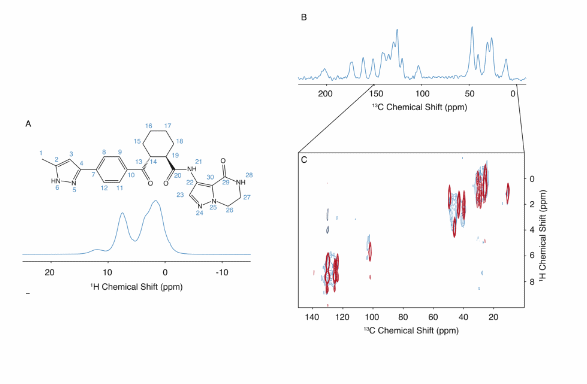
Unveiling the structure of amorphous drugs by NMR Crystallography

Figure: (A) 900 MHz 1D 1H spectrum of amorphous atuliflapon acquired at 298 K with an MAS rate of 62.5 kHz. (B) 125 MHz 1D 13C CPMAS spectrum acquired at 298 K with a MAS rate of 22 kHz. (C) 2D 1H–13C HETCOR spectra collected for the crystalline (red/black) and amorphous (blue) forms at 298 K with a MAS rate of 22 kHz at a 13C Larmor frequency of 125 MHz. Reprinted from Holmes et al, Faraday Discuss. 2024. Licensed under Creative Commons Attribution 4.0 International License (CC BY 4.0).
Atomic-level insight help in understanding how hydrogen bonding and molecular conformations stabilize amorphous drug forms. NMR Crystallography offers precise structural information, even for non-crystalline substances, helping to optimize drug formulation. The findings enable better stability and longer shelf-life for amorphous drugs, ensuring enhanced pharmaceutical efficacy.

Read more

Enhancing drug formulations with DNP-Enhanced NMR for inhalable protein-based medications

DNP solid-state NMR spectroscopy was applied to determine the hierarchy of components within spray-dried particles containing protein, trehalose, leucine, and trileucine. Reprinted from Berruyer et al, Mol. Pharmaceutics 2023, 20, 5682–5689. Licensed under Creative Commons Attribution 4.0 International License (CC BY 4.0)
Detailed insight into the internal structure of protein-based drug formulations enable better aerosol properties and stability. Advanced NMR Technology: DNP-enhanced NMR allows for the precise characterization of multicomponent formulations, supporting more efficient drug development.By understanding the layering of amino acids and their effects on dispersibility, more effective inhalable therapies can be created.

Read more

Optimizing industrial zeolite catalysts for methanol dehydrationwith two-dimensional solid-state NMR

Solid-state 2D 27Al−29Si J-HMQC NMR spectra of hydrated H+-chabazite (H+-CHA) zeolites. Reprinted with permission from Schmithorst et al, J. Am. Chem. Soc. 2023, 145, 18215–18220. Copyright 2023 American Chemical Society.
Atomic-level insight into aluminum pairing enables the design of more efficient zeolite catalysts. Optimized catalysts lead to better performance in critical processes like methanol dehydration and NOx reduction, both key to the chemical and environmental industries. 2D NMR offers a precise method to visualize catalyst structures, helping tailor materials for higher efficiency and selectivity in reactions.

Read more

DNP-enhanced solid-state NMR: a unique technique to investigate vaccine formulations

DNP-enhanced solid-state NMR: a unique technique to investigate vaccine formulations
Improved Vaccine Design: By revealing how aluminum gels interact differently with antigens, this study provides unique insight that could be used to enhance vaccine efficacy. The use of DNP-enhanced NMR opens new avenues for rapid and detailed analysis of complex interfaces, streamlining vaccine development.

Read more

PANACEA-nmr.eu | Solid-state NMR Trans-national Access
contact@panacea-nmr.eu
News Privacy policy Terms and conditions
EU logo

This project has received funding from the European Union’s Horizon 2020 research and innovation programme under Grant Agreement No 101008500

Actucom : Scientifc website design

Webdesign Actucom.eu

preload
We respect your privacy and treat your personal data in accordance with the GDPR.
We use cookies so as to improve our site and your user experience.
I UNDERSTOOD
More information